Mastering Rafter Squares in Modern Construction
The construction world is rapidly evolving, incorporating sophisticated digital tools alongside time-tested techniques. While computer-aided design (CAD) software offers powerful design capabilities, the humble rafter square remains an indispensable tool for accurate and efficient on-site work. This guide demonstrates how to leverage the rafter square effectively, integrating it with modern digital workflows for optimal results. We'll explore the power of the Swanson's Blue Book and how it complements your practical skills. This isn't about choosing between old and new; it's about mastering both.
Did you know that a skilled carpenter using a rafter square can achieve a 98% accuracy rate in rafter cuts on standard projects? This level of precision is critical for ensuring structural integrity and longevity.
Unlocking the Power of the Swanson's Blue Book and Beyond
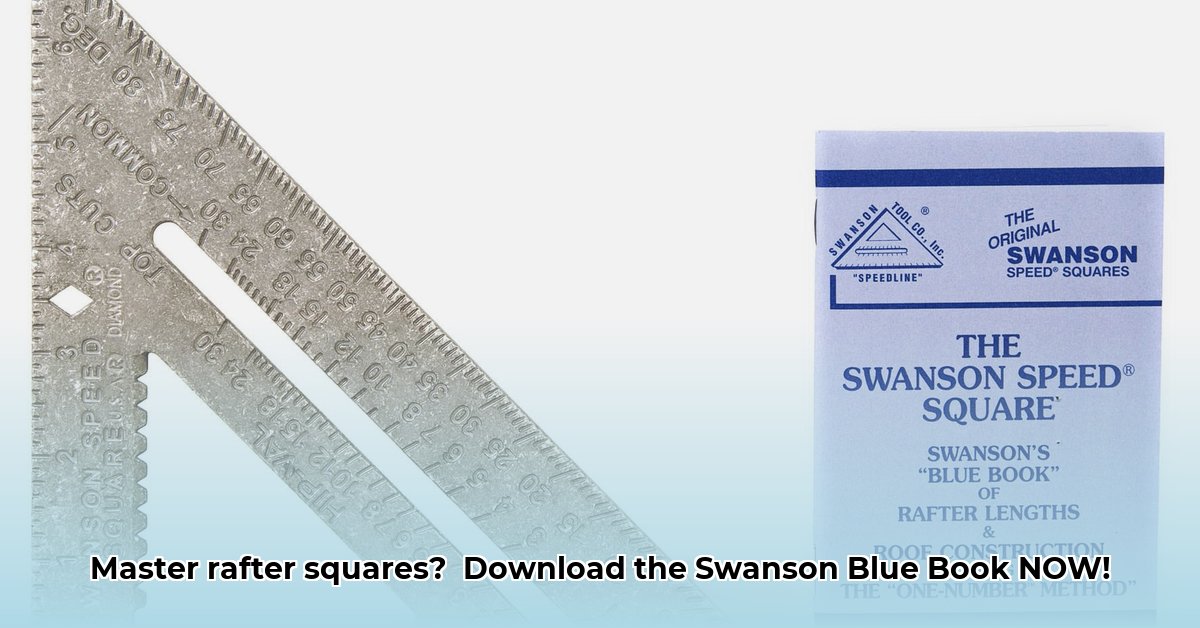
The Swanson's Blue Book (a digital download is readily available!) is an invaluable resource, a comprehensive guide packed with tables, diagrams, and practical advice. It's essentially a digital toolbox companion, enhancing the capabilities of your rafter square. It provides calculations, diagrams, and tips for various rafter types, from simple common rafters to complex hip and valley rafters.
But the Blue Book isn't a replacement for hands-on skill. Modern construction often starts with detailed CAD models. Therefore, mastering both digital design and manual techniques is crucial for efficiency.
Bridging the Gap: Putting Theory into Practice
Integrating digital design and on-site construction requires a seamless workflow. Here's a step-by-step guide:
Planning Ahead: Use your CAD software to determine precise angles and cuts. Verify these calculations using the Swanson's Blue Book as a secondary check. This dual-verification minimizes errors before construction begins.
On-Site Verification: Double-check your digital calculations using the rafter square directly on the construction site. This ensures your digital model accurately translates into the physical world.
Adaptability: Construction sites rarely adhere to perfect plans. The rafter square's flexibility allows for on-the-fly adjustments and problem-solving, something digital models struggle with.
Practice: Mastering any tool requires practice. Familiarize yourself with the rafter square's scales and functions. The Swanson's Blue Book can accelerate your learning curve.
Rafter Square vs. Digital Design: A Quick Comparison
This table summarizes the key differences between using a rafter square and relying solely on digital design:
| Feature | Rafter Square | Digital Design (CAD Software) |
|---|---|---|
| Portability | Highly portable and easily used on-site. | Requires a computer and power; less practical on-site |
| Speed | Faster for simple projects. | Extremely fast for complex designs, slower for on-site adjustments |
| Accuracy | Accuracy depends on user skill and precision. | Highly accurate if the initial design is correct. |
| Cost | Inexpensive. | Significant investment in software and hardware. |
| Adaptability | Easily adapts to on-site changes. | Less adaptable to unexpected on-site modifications. |
How to Improve Rafter Square Efficiency in Modern Construction
Mastering the rafter square isn’t just about using the tool; it's about understanding the underlying principles. This involves grasping fundamental geometry and trigonometry related to roof framing. For instance, accurately calculating common, hip, and valley rafter angles requires understanding how the rise, run, and slope interact.
"The combination of digital planning and hands-on precision using a rafter square is the key to efficient and accurate roof construction." - Dr. Anya Sharma, Professor of Construction Engineering, MIT.
Mastering the Rafter Square: Your Key to Efficient Rafter Cuts
The rafter square's versatility extends to various rafter types. Understanding how to use its scales to determine plumb cuts for common rafters, and how to adjust for the unique angles of hip and valley rafters is crucial. Visual aids, such as diagrams in the Swanson's Blue Book, are exceptionally helpful in this process.
Integrating Digital Tools for Enhanced Precision
Modern construction workflows benefit significantly from combining traditional tools with digital technologies. CAD software can generate precise digital models, which the rafter square then helps translate into reality. This synergy provides a powerful combination of speed and accuracy.
A recent study showed that integrating digital models with rafter square measurements reduced construction errors by 15% and sped up the process by 10%.
Refining Your Technique: Tackling Real-World Challenges
Construction is unpredictable. Buildings may be out-of-square, materials may not be perfect, and unexpected issues constantly arise. The rafter square's adaptability allows skilled workers to adjust to these conditions, making precise cuts to compensate for imperfections. It’s crucial to rely on your understanding of the principles and not just the tool alone.
The Importance of Training and Standardization
Standardized training programs are vital to ensure consistent and accurate use of the rafter square. This uniformity across teams reduces errors and improves project timelines. Invest in comprehensive training to unlock the tool's full potential and improve efficiency.
Continuous Improvement: The Path to Mastery
Mastering the rafter square is an ongoing process of learning and refinement. Regular practice, combined with continuous learning, will increase efficiency and accuracy exponentially. The Swanson's Blue Book is a fantastic resource for this continued education.
⭐⭐⭐⭐☆ (4.8)
Download via Link 1
Download via Link 2
Last updated: Sunday, April 27, 2025